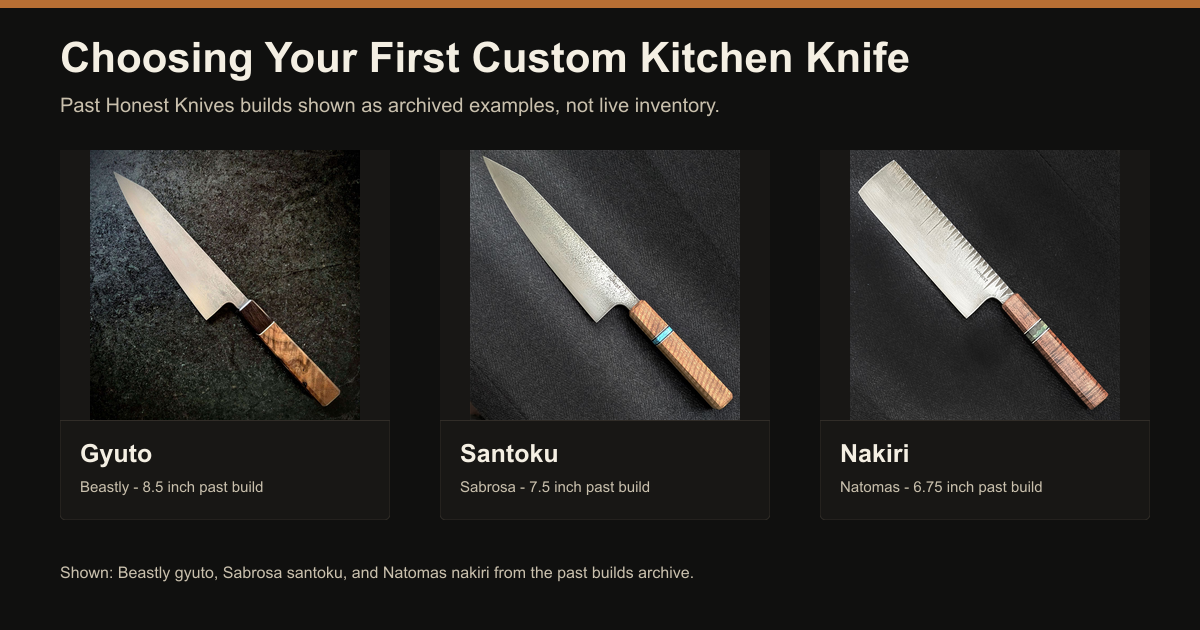
Your first custom kitchen knife should probably be a practical daily driver, not the wildest knife you can imagine. For most serious home cooks, that means an 8-inch gyuto or chef-style knife with comfortable balance, stainless steel, thin geometry, and enough toughness for real board work.
TL;DR
- Start with the knife you’ll use most, not the most specialized shape.
- For most cooks, an 8-inch gyuto is the safest first custom knife.
- Geometry matters more than steel hype.
- Past build pages are archived examples, not live inventory.
- If the style feels right, join the waitlist and explain how you cook.
What should your first custom kitchen knife be?
For most people, the best first custom kitchen knife is an all-purpose blade that handles vegetables, proteins, herbs, and daily prep without needing special treatment every five minutes. I’d rather see someone buy one knife they reach for constantly than three specialty knives that mostly sit in a drawer.
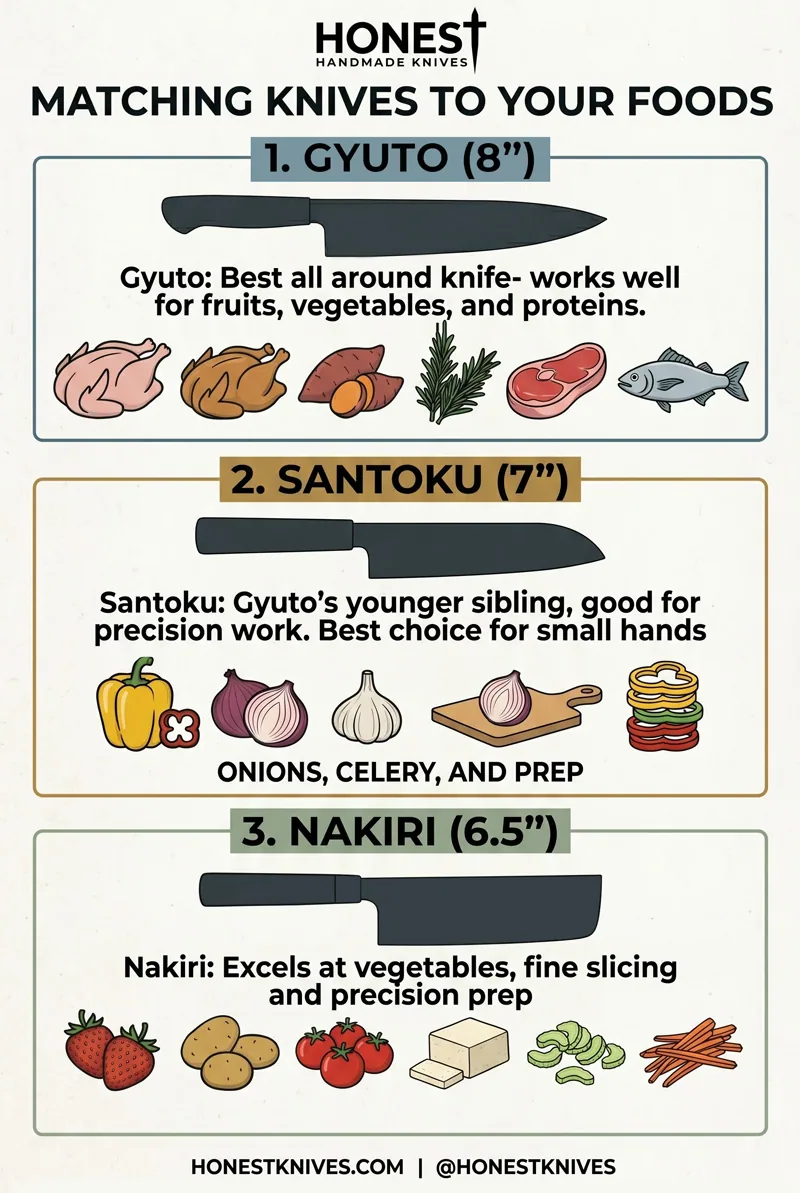
That usually points toward a gyuto or chef-style knife. A gyuto gives you length, tip control, and enough height at the heel for comfortable board work. It can slice, chop, mince, and handle most normal dinner prep without feeling like a compromise.
A santoku can also be a great first custom knife if you prefer something shorter and more compact. A santoku is often easier to control on a smaller board, especially if you don’t like longer blades.
The first question is not “What knife is best?” It’s “What knife will you actually use?”
Start with how you cook
Here’s what I’d look at before choosing a custom knife: your board size, grip, cutting motion, food habits, and tolerance for maintenance. Those details matter more than a spec sheet.
If you cook big meals, break down piles of vegetables, or prep proteins often, you’ll probably appreciate a longer gyuto. If you mostly cook weeknight dinners in a smaller kitchen, a shorter gyuto or santoku may feel less fussy.
If you push cut or chop straight down, you may like a flatter profile. If you rock through herbs, you’ll want a little more belly in the edge. Neither is automatically better. The knife has to match the motion.
This is where buying from a small maker helps. You can describe your cooking in plain English. “I cook every night and want one serious all-purpose knife” is a better starting point than copying forum specs you don’t actually care about.
Best first custom knife shapes
Gyuto
A gyuto is my usual first recommendation because it covers the most ground. Think of it as a Japanese-style chef knife: long enough for efficient slicing, pointed enough for detail work, and tall enough for board comfort.
Best for:
- One serious all-purpose kitchen knife
- Vegetables, proteins, herbs, and general prep
- Cooks who want a familiar chef-knife role with better performance
Not best for:
- Tiny cutting boards
- People nervous around longer blades
- Heavy bone work or rough use
You can browse archived gyuto builds to see previous examples. Those pages are past work, not live inventory.
Santoku
A santoku is shorter, compact, and easy to manage. It can be a better first custom knife if you want something nimble and less intimidating than a full-size gyuto.
Best for:
- Smaller kitchens
- Shorter prep sessions
- Cooks who like compact control
Not best for:
- Long slicing cuts
- Big proteins
- People who want maximum blade length
The archived santoku builds show how much variation can exist inside the same general style.
Nakiri
A nakiri is a vegetable specialist. It has a flatter edge and tall blade, which makes it excellent for board work. If vegetables are 80 percent of your prep, a nakiri can make a lot of sense.
Best for:
- Vegetable-heavy cooking
- Push cutting and chopping
- Clean board contact
Not best for:
- Your only knife if you prep lots of meat
- Rocking cuts
- Fine tip work
Slicer or sujihiki
A slicer is more specialized. It’s built for long, clean cuts through proteins, brisket, roasts, fish, or cooked meats. It’s a great second or third custom knife, but usually not the first.
Best for:
- BBQ, roasts, fish, and clean protein slices
- People who already have a daily prep knife
Not best for:
- General chopping
- Tight board work
- First custom knife for most home cooks
See the archived slicer builds if you want examples of how these knives are shaped.
Size matters, but not the way people think
A longer knife is not automatically more “professional.” A shorter knife is not automatically easier. The right size depends on your board, hands, comfort level, and the food you cook.
For a first custom knife, I’d usually look at these ranges:
- 7 to 7.5 inches: compact, nimble, less intimidating
- 8 to 8.5 inches: the sweet spot for most all-purpose knives
- 9 inches and up: efficient, but better for larger boards and confident users
If you’re unsure, don’t start huge. A knife that feels slightly too small will still get used. A knife that feels too big may stay parked in the block while you reach for something easier.
Steel is important, but geometry does the cutting
Steel matters. Heat treatment matters. But the blade geometry is what you feel every time the knife moves through an onion.
A thick knife can be technically sharp and still wedge through food. A thin knife with smart geometry can feel sharp longer because it moves through food with less resistance. That’s why I care so much about thin grinds, edge stability, and the way the blade tapers behind the edge.
If you want the longer version, read the Honest Knives article on AEB-L kitchen knife steel. AEB-L has been a favorite in my shop because it can take a fine edge, stay tough, and support thin kitchen geometry when heat treated well.
The practical version is simple: don’t buy a steel name. Buy the whole system. Steel, heat treatment, geometry, and intended use all have to work together.
Handle comfort is not decoration
A good handle should disappear in use. That doesn’t mean boring. It means the shape, size, balance, and finish should let you prep dinner without thinking about your grip every thirty seconds.
Some cooks like a western handle because it feels familiar. Others like a wa-style handle because it can feel lighter and more forward-balanced. Neither is automatically better.
If you have large hands, small hands, wrist issues, or a strong grip preference, say so before buying. A custom knife should fit the cook, not just photograph well.
What past builds can tell you
Past build pages are useful because they show real examples of blade shape, handle material, finish, size, and maker style. They are not a live store shelf.
Use the past builds archive to answer practical questions:
- Do I like longer or shorter blades?
- Do I prefer simple handles or louder materials?
- Do I want a workhorse or a thin laser?
- Do I gravitate toward gyutos, santokus, nakiris, or slicers?
- Do the field notes sound like the way I cook?
That last one matters. If a build was made for an avid home cook who wanted a daily driver, and that sounds like you, pay attention. If it was built as a big brisket slicer and you mostly dice shallots, that’s probably not your first knife.
Custom knife vs small-batch knife
“Custom” can mean different things. Some makers take individual commissions with every detail chosen up front. Honest Knives is currently focused on limited small-batch drops through a waitlist, not a normal always-in-stock store.
That means the better approach is to understand what you want, study the past builds, and join the waitlist when the work feels like a fit. When your turn comes up, you can decide whether a finished knife from that batch matches your cooking.
You are not trying to win a race. You’re trying to get the right tool.
A simple buying checklist
Before joining a waitlist or buying your first handmade kitchen knife, ask yourself:
- What knife do I reach for most right now?
- What frustrates me about it?
- Do I want one all-purpose knife or a specialist?
- What size blade feels comfortable on my board?
- Do I push cut, chop, or rock?
- Do I want stainless ease of care?
- Am I gentle with knives, or do I need extra toughness?
- Do I care more about performance, looks, or both?
There’s no shame in wanting the knife to look good. I like beautiful handles too. But if performance matters, looks should come after shape, geometry, balance, and steel choice.
When a custom knife is probably not right yet
A custom kitchen knife may not be the right first move if you want a dishwasher-safe tool, plan to cut frozen food, regularly twist through bones, or don’t want to think about cutting boards and hand washing.
That’s not gatekeeping. It’s just being honest. Thin handmade kitchen knives are built to cut food beautifully. They are not pry bars with pretty handles.
If you’re willing to hand wash, use a decent board, and avoid abusive tasks, a custom knife can be a huge upgrade. If not, a tougher production knife may be the better tool for now.
Ready to narrow it down?
If this is your first custom kitchen knife, start with the practical choice. For most cooks, that means an 8-inch-ish gyuto or a compact santoku in stainless steel with thin geometry and a comfortable handle.
Browse the past builds archive to see previous Honest Knives work, then read a few customer reviews to understand how the knives perform in real kitchens. If the approach fits how you cook, join the waitlist and reply to the welcome email with what you’re looking for.
No magic words needed. Just tell me what you cook, what you use now, and what you want the knife to do better.
FAQ
What is the best first custom kitchen knife?
For most home cooks, the best first custom kitchen knife is an 8-inch gyuto or chef-style knife. It handles the widest range of prep work and gives you the best chance of using the knife every day.
Is a gyuto better than a chef knife?
A gyuto is not automatically better than a chef knife. It usually feels thinner, lighter, and more precise than many Western production chef knives, but the right choice depends on your cutting style and comfort level.
Should I choose AEB-L steel for my first custom knife?
AEB-L is a strong choice for many kitchen knives because it can be tough, stainless, easy to sharpen, and suitable for thin geometry when heat treated well. The steel still has to be matched with good design and proper use.
Are past builds available to buy?
No. Honest Knives past build pages are archived examples of previous work, not live inventory. Use them to understand blade shapes, materials, finishes, and maker style before joining the waitlist.
Should my first custom knife be a nakiri?
A nakiri can be a great first custom knife if you mostly cook vegetables and already know you like flatter profiles. If you want one all-purpose knife for everything, a gyuto or santoku is usually safer.